
The horizontal ship-mounted sand pump is a core centrifugal wear-resistant pump for dredging and sand mining projects. It is widely matched with cutter suction dredgers and jet suction dredgers to deliver solid-liquid mixed slurry containing sand, stones and silt. Featuring large flow rate, excellent wear resistance and long-distance slurry conveying capacity, it serves as the main pump type for river dredging, sand field mining and tailings transportation projects.
1. Working Principle
Driven by high-speed rotation, the impeller of the horizontal sand pump generates centrifugal force and creates negative pressure at the impeller inlet to suck underwater sand-water mixture into the pump chamber. The sand-water medium gains kinetic energy inside the impeller and then enters the volute casing, where kinetic energy is converted into pressure to continuously push slurry through the sand discharge pipeline to the designated sand stacking area. The pump body adopts a widened flow passage to allow sand and stone particles of certain particle sizes to pass through. The wetted parts are made of high-chromium alloy to resist continuous scouring and wear from sand particles. The pump can be driven by diesel engine or electric motor, suitable for continuous open-air operation on vessels.

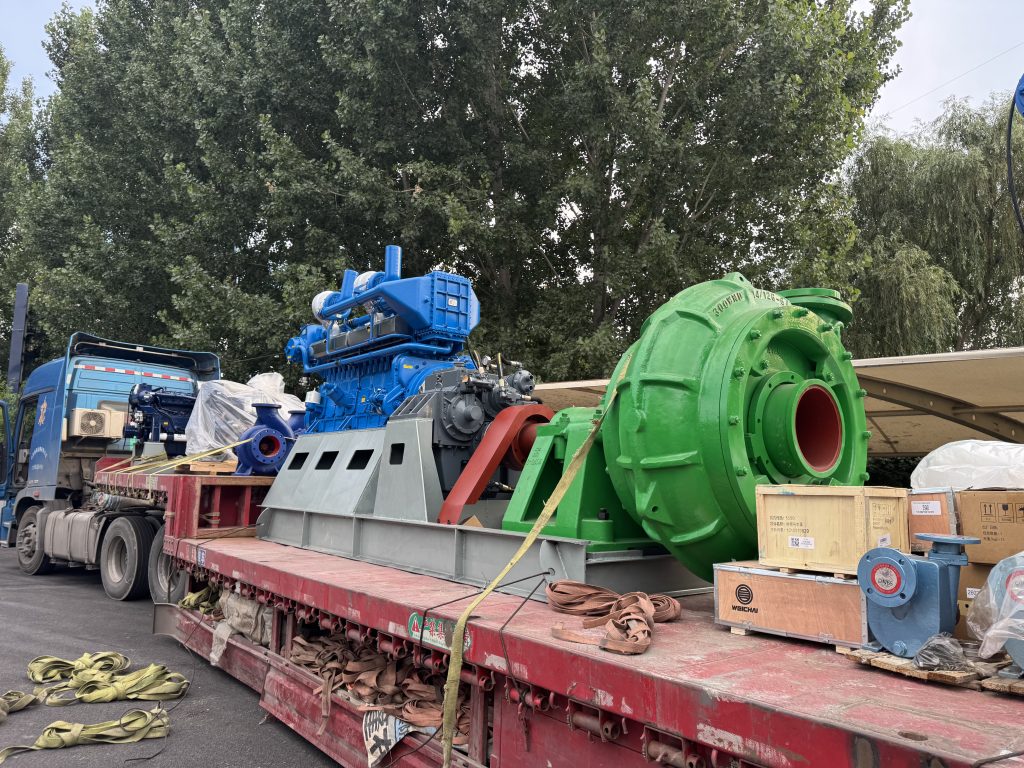
2. Product Classification
2.1 Classification by Caliber Common sizes include 6-inch, 8-inch, 10-inch, 12-inch and 14-inch horizontal sand pumps.
2.2 Classification by Power Mode Motor-driven type and diesel direct-driven type.
2.3 Classification by Working Conditions & Medium The fresh water type is used for inland river and reservoir sand extraction. The seawater type adopts wear and corrosion-resistant wetted parts with anti-corrosion coating to resist seawater salt spray corrosion and sand abrasion. According to conveyed media, it can be divided into ordinary fine sand pumps and gravel pumps. Gravel pumps are equipped with larger flow passages for mixtures containing pebbles.
3. Installation Points
3.1 Foundation and Pump Fixation For shipboard installation, fix the pump on a stable base of the vessel with shock absorption pads, and tighten anchor bolts to prevent pump displacement caused by operation vibration.
3.2 Pipeline Assembly Requirements Keep the suction pipeline as short as possible and reduce elbows. Install a filter at the suction inlet to prevent large stones and weeds from entering the pump chamber. Fit rubber gaskets on flanges of floating sand discharge pipes to ensure tight sealing. Support pipelines firmly to avoid pulling force exerted on the pump body.
3.3 Transmission Connection Adjustment For the coupling direct-connected model, correct the coaxiality of pump shaft and power shaft. For the belt-driven model, adjust belt tightness.
3.4 Commissioning and Trial Operation Fill the pump with water and exhaust air inside the pump before startup. Run it with no load first to check abnormal noise and leakage, then gradually apply load and monitor slurry flow and pump vibration.
4. Common Faults and Solutions
4.1 No Sand Output or Low Sand Output Causes: Air leakage in suction pipeline, blockage of bottom valve / suction filter, severe impeller wear, insufficient priming water inside pump. Solutions: Inspect suction pipeline and repair air leakage; clean sundries on filter; replace worn impeller; refill the pump for priming.
4.2 Severe Pump Vibration and Abnormal Noise Causes: Loose anchor bolts, unbalanced impeller, large hard particles sucked in, damaged bearing. Solutions: Stop the unit and tighten bolts; disassemble pump to remove foreign matters; inspect bearings and replace damaged ones; calibrate impeller balance.
4.3 Slurry Leakage at Pump Casing and Flange Causes: Aged or damaged flange gaskets, uneven bolt tightening, worn and perforated pump liner. Solutions: Tighten flange bolts evenly and replace damaged gaskets; replace wear-resistant lining when the liner is heavily worn.
4.4 Bearing Overheating Causes: Insufficient lubricating oil, deteriorated oil quality, damaged bearing, poor coaxiality. Solutions: Refill or replace lubricating oil; correct coaxiality; replace damaged bearing.
5. Daily Maintenance
5.1 Pre-operation Inspection Check lubricating oil, pipeline sealing and fasteners before daily startup.
5.2 Post-operation Cleaning Flush pump body and pipelines with clean water after operation to drain residual sand inside.
5.3 Regular Inspection of Wearing Parts Regularly inspect the wear of wetted components such as impeller, sheath and guard plate, and prepare spare wearing parts in advance.
5.4 Long-term Shutdown Preservation For long-term shutdown, disassemble pipelines, clean sediment in pump chamber and implement anti-rust protection.


