
For Indonesia’s vast mining, dredging, and marine engineering projects, handling highly abrasive and high-concentration slurries and sediments is a continuous and significant challenge. From nickel mine tailings transportation in Sulawesi to river widening in Kalimantan and large-scale land reclamation on Batam Island, traditional solutions are often limited by equipment power, durability, and flexibility in deployment in complex terrains. As project scales continue to expand and environmental standards become increasingly stringent, the market urgently needs a modern solution that combines powerful performance, exceptional reliability, and superior energy efficiency.
In this context, high-power submersible sand pump technology is becoming a core driving force for industry transformation. This article will use the 160kW ZJQ series heavy-duty submersible sand pump and its successful export to Indonesia as a typical case study for in-depth technical analysis and market application interpretation. This case not only demonstrates how engineering intelligence can address extreme working conditions but also outlines a complete export blueprint from the Chinese factory to the Indonesian project site, encompassing both technical performance and international logistics.
1.Part One: Technical Core Analysis – Engineering Innovations of the 160kW Submersible Sand Pump
1.1 Design Philosophy: Built for High-Intensity, Continuous Operation
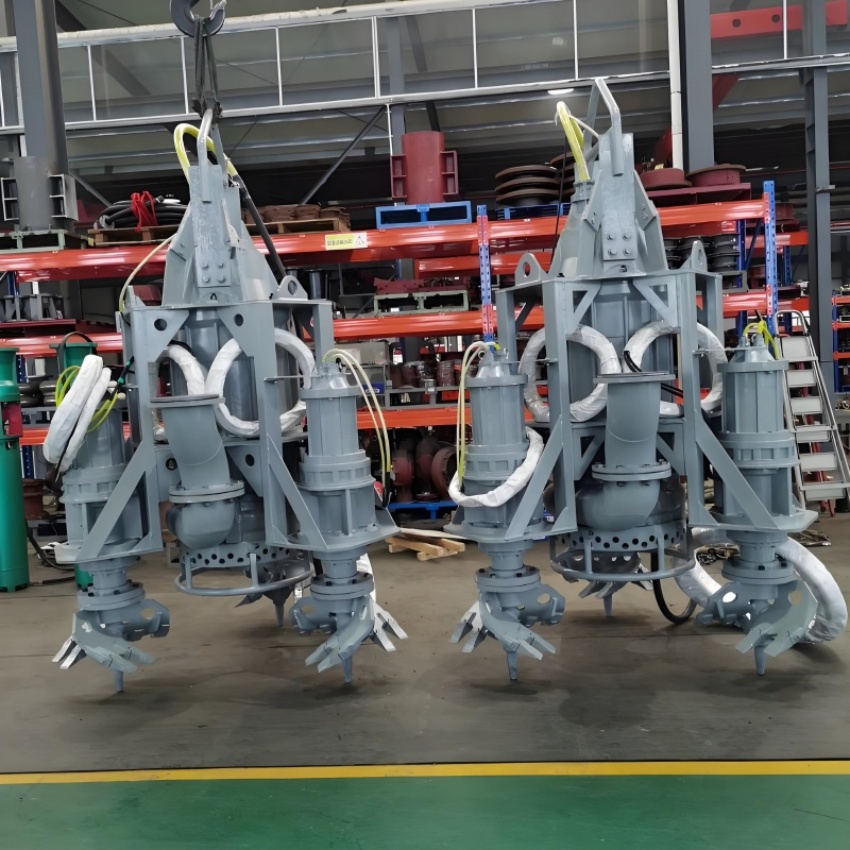
The 160kW ZJQ pump is not simply a scaled-up version of a low-power device, but a redesign specifically for large-scale, industrial operations. Its core concept is to achieve maximum uptime, minimum energy consumption per unit volume, and ultimate durability. The pump adopts an integrated design with a heavy-duty submersible motor directly connected to a high-efficiency pump body, eliminating the vibration, alignment problems, and energy losses associated with long-shaft drives. The structure is compact, and power transmission is direct and efficient.
1.2 Dual Hydraulic Modules: Seamless Synergy of Agitation and Pumping
High-Efficiency Agitator: The pump bottom integrates a heavy-duty rotating agitator. Its independent impeller design generates powerful vortices, effectively breaking up compacted sand layers, clay lumps, or deposited tailings, ensuring their complete fluidization. This is crucial for handling the highly viscous materials commonly found in Indonesia, ensuring a continuous supply of high-concentration slurry at the pump inlet and improving overall efficiency from the source. Main Pumping Impeller: Based on computational fluid dynamics (CFD) optimization, the large-channel, anti-clogging impeller design is specifically engineered for pumping highly abrasive slurries with high solid content (up to 60-70% by weight concentration) and large particles (capable of handling gravel up to 80-120mm through customized processing). Its unique flow channel shape minimizes turbulence and internal impact, thereby reducing wear and improving operational stability.
1.3 Extreme Durability: Breakthroughs in Materials and Sealing
Ultra-Wear-Resistant Material Set: All wetted parts (pump casing, agitator impeller, main impeller, wear plate) are cast from Cr30 ultra-high chromium alloy. After special heat treatment, the surface hardness reaches HRC 62-65. Its resistance to quartz sand abrasion is 2-3 times that of ordinary high-chromium alloys, which is particularly advantageous when conveying extremely hard particles such as nickel mine tailings.
Multiple Protection Sealing System: Equipped with a series mechanical seal and integrated with an independent oil chamber for lubrication and pressure balancing. This oil chamber has a leakage sensor, which provides early warning in case of even minor leakage from the primary seal, preventing seawater intrusion into the motor. The entire sealing system is designed for continuous and reliable operation at depths of 30-50 meters underwater.
Intelligent Motor Protection: The 160kW heavy-duty motor has multiple built-in Pt100 temperature sensors, humidity sensors, and winding protection devices. Real-time data is transmitted to the ground control cabinet via corrosion-resistant cables, providing comprehensive protection against overload, overheating, water leakage, undervoltage, and phase loss, ensuring long-term operation in hot and humid tropical environments.
1.4 Key Performance Parameters at a Glance (Taking the typical 160kW model as an example)
Power Range: 160 kW (main motor), configurable with variable frequency control for soft start and flow adjustment.
Flow Rate and Head: The optimal operating range is 800 – 1500 m³/h, with a maximum head of 45 – 60 meters. With proper pipeline design, horizontal conveying distances easily exceed 1000 meters.
Medium Handling Capacity: The standard model can handle solid particles up to 50mm in diameter. For tree roots and debris in Indonesian waterways, we offer reinforced agitators with cutting capabilities.
Power adaptability: Standard versions are available in 380V/50Hz or 440V/60Hz, and customized high-voltage models such as 690V and 1140V are available to adapt to large power grids in mining areas and reduce line losses.


2.Part Two: Export Practicalities – Precise Delivery from Chinese Factory to Indonesian Project Site
2.1 Export Packaging Conforming to International Standards
To ensure that heavy equipment remains intact after long-distance sea transport (typically 10-15 days from China to major Indonesian ports) and subsequent inland transportation, we implement strict packaging protocols:
Wooden Packaging Treatment: All solid wood pallets and frames used for reinforcement and support are heat-treated or fumigated according to the ISPM-15 international standard and bear official certification marks to ensure smooth customs clearance regarding plant quarantine.
Comprehensive Anti-rust Protection: The pump body and metal accessories are first coated with anti-rust oil, then tightly wrapped with vapor phase corrosion inhibitor (VCI) film, which continuously releases anti-rust molecules in a confined space. Sufficient desiccant is also placed inside the packaging box to control humidity.
Customized Inner Lining and Fixing: High-density EPS foam or molded EVA material is used to create custom-fit slots for precision components such as the pump body and electrical control cabinet. Straps are used to securely fasten them to the box, preventing any movement or collision during transportation.
Clear Labeling: The outer packaging box is clearly marked with internationally recognized symbols for lifting points, center of gravity, rain protection, and “do not invert,” as well as detailed cargo information, dimensions, gross weight, and HS code (usually 8413.70 – centrifugal pumps), facilitating handling and customs clearance.
2.2 Logistics and Customs Clearance Navigation
Main Shipping Routes: Typically, shipments depart from major ports such as Shanghai, Ningbo, or Guangzhou, and arrive directly at Indonesian ports such as Jakarta (Tanjung Priok), Surabaya (Tanjung Perak), or Batam. Core Documents:
Commercial Invoice and Packing List: Detailed listing of goods value, model, and quantity, serving as the basis for customs valuation and taxation.
Clean Bill of Lading: The key document proving ownership of the goods.
Certificate of Origin: Generally, a CO (Certificate of Origin) is provided. If necessary, a Form E China-ASEAN Free Trade Area Preferential Certificate of Origin can be obtained to help Indonesian importers enjoy tariff reductions.
Compliance Documents: Including product quality certificates, test reports, and operation manuals (Indonesian version recommended).
Key Points for Indonesian Customs Clearance: Indonesian customs clearance procedures are relatively strict. Importers need to prepare an import license (API) and taxpayer registration number (NPWP) in advance, and ensure that the goods comply with the relevant requirements of Indonesian National Standards (SNI) for electrical equipment (if applicable). Experienced exporters will assist in providing complete technical documents to support the customs clearance process.

3.Part Three: In-depth Case Study – Application of a 160kW Pump in an Indonesian Nickel Mine Tailings Reprocessing Project
3.1 Project Background and Challenges
The client is a large nickel mining company on Sulawesi Island, Indonesia. Their historical tailings pond contains a large amount of fine sand and mud mixture containing residual nickel-iron minerals, which has recovery value. The traditional solution involved using multiple small pumps with long pipelines and large excavating equipment for dilution and transportation, which presented the following problems:
Low efficiency and high energy consumption: The system was complex, requiring a large amount of water for dilution, resulting in huge pumping volumes and extremely high electricity and water costs.
Rapid equipment wear: The mineral particles are highly abrasive, and the service life of the flow-through parts of ordinary pumps is only 400-500 hours. Frequent replacement leads to high maintenance costs and disrupts production continuity.
Inflexible deployment: The tailings pond is large, and the water level and operating points change frequently, making it extremely difficult to move a fixed pumping station system.
3.2 Customized Solution Deployment
After an on-site inspection by our technical team, we proposed an alternating operation plan based on two 160kW ZJQ submersible sand pumps:
Pump Selection: We selected an enhanced version made of Cr30 material, optimized for extremely hard and abrasive materials, and increased the agitator power to ensure effective crushing of the tailings at the end of the plate.
System Configuration: Each pump is equipped with an independent variable frequency control cabinet, which can adjust the speed in real time according to pipeline resistance and concentration, optimizing energy consumption. It is equipped with ultra-high molecular weight polyethylene (UHMWPE) pipes (DN250), which have a smooth inner wall, 5-7 times the wear resistance of steel pipes, and are lightweight, making them easy to move within the tailings pond.
Operation Method: The pump body is suspended in the tailings slurry pool by a float. As the working face advances, it can be quickly moved by simply dragging the float and hose, eliminating the need to build a fixed platform.
3.3 Operational Results and Benefit Analysis
Production Capacity Leap: A single pump stably delivers a flow rate of 900 m³/h when transporting dense slurry with a concentration of up to 65%, transporting it to the processing plant 1.2 kilometers away.
Durability Breakthrough: Under such harsh working conditions, the Cr30 flow-through components achieved a first maintenance life of over 2000 hours, more than 4 times that of the original equipment, significantly reducing spare parts consumption and downtime.
Improved Overall Energy Efficiency: Thanks to the direct pumping of high-concentration slurry (without extensive dilution) and the application of variable frequency technology, the power consumption per ton of slurry transported was reduced by approximately 35%. Water consumption was reduced by 70%.
Return on Investment: Although the initial equipment investment was higher, thanks to the impressive energy savings, extremely low maintenance costs, and increased recovery yield, the customer calculated that the project investment payback period would be completed within 6-8 months.
Part Four: Why High-Power Submersible Pumps are Becoming the Trend in the Indonesian Market
Compared with traditional horizontal centrifugal pumps and dredgers, 160kW-class submersible sand pumps demonstrate overwhelming advantages in the Indonesian market:
Unparalleled Deployment Flexibility: No need for a fixed pump house or complex intake pool construction. Suitable for a variety of dynamic scenarios such as river dredging, tailings pond desilting, cofferdam dewatering, and island reclamation, it is particularly well-suited to Indonesia’s multi-island and multi-waterway geographical characteristics.
Excellent energy efficiency: Directly submerged in the slurry, the suction head loss is almost zero, and it can handle higher concentrations of materials, significantly reducing ineffective water transport and resulting in lower energy consumption per unit of output.
Extremely low overall maintenance costs: Modular design facilitates easy replacement of key wear parts. The application of ultra-wear-resistant materials extends maintenance intervals significantly. With the increasingly完善 local technical support network in Indonesia, operating costs are effectively controlled.
Environmental friendliness: Low noise during underwater operation (<75 decibels), minimizing disturbance to surrounding communities. Fully electric drive achieves zero emissions at the work site, complying with increasingly stringent environmental regulations.
4.Conclusion: Empowering Indonesian Resource and Infrastructure Development with Engineering Expertise
The case of the 160kW heavy-duty submersible sand pump exported to Indonesia clearly demonstrates the immense value that deeply engineered solutions tailored to specific market challenges can create. It is not just a pump, but a system engineering solution encompassing advanced materials science, intelligent control, customized design, and global logistics support.
For Indonesian mining companies, dredging contractors, and engineering construction companies committed to improving operational efficiency, reducing long-term costs, and practicing sustainable development, investing in such high-performance, highly reliable modern equipment is no longer simply a cost expenditure, but a strategic choice to build long-term core competitiveness. Osen Pumps will continue to leverage its solid technological innovation and global project experience to provide cutting-edge and reliable engineering solutions for complex material handling challenges in Indonesia and throughout Southeast Asia.


